
America's FIFA Divide
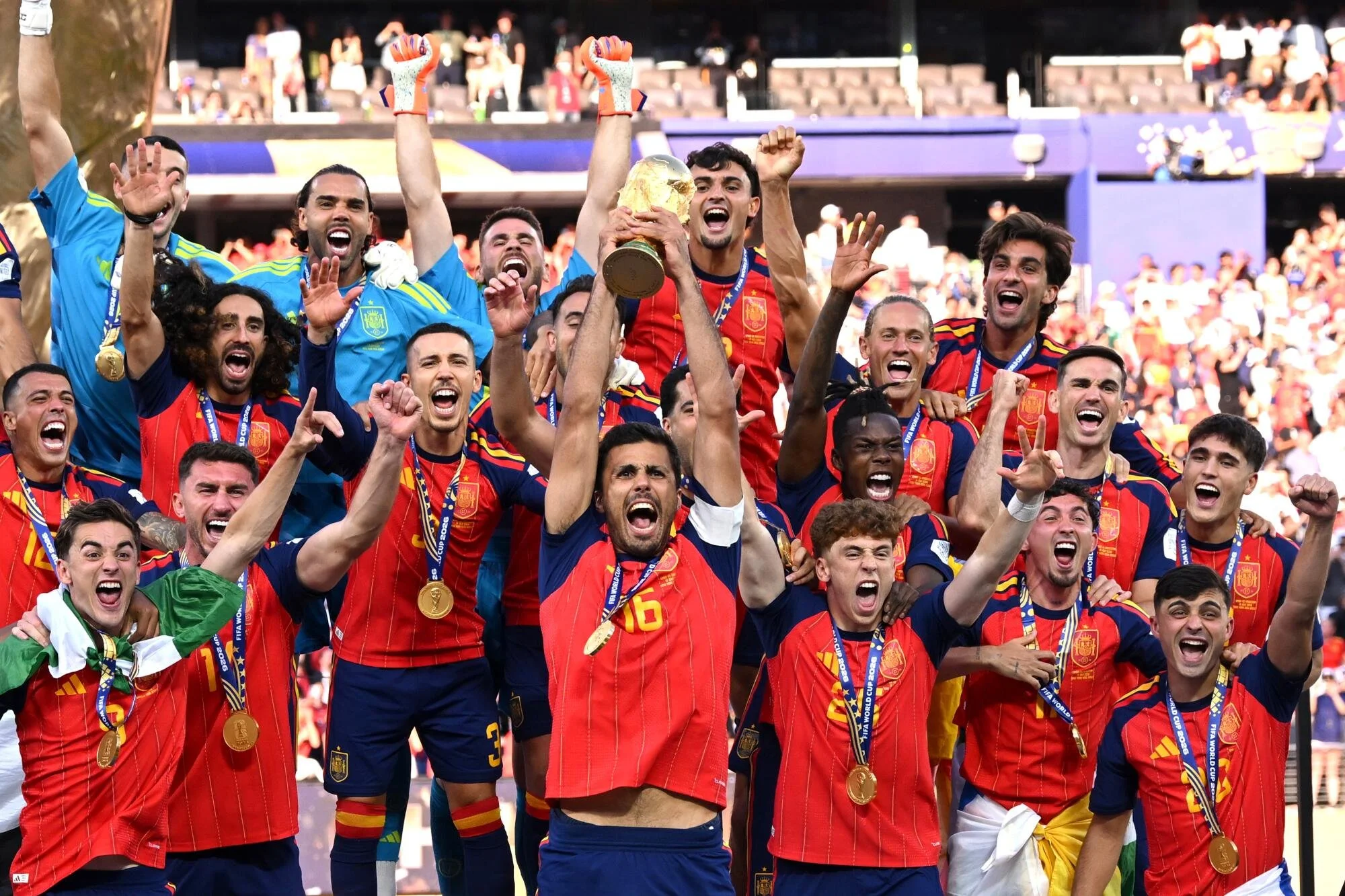
Credit: LA Times
The 2026 World Cup has been a remarkable spectacle. For the first time since 1994, the world’s most popular sport’s biggest stage has returned to the US, along with several matches held in Canada and Mexico. As is tradition, the World Cup has an unparalleled ability to create moments of cultural fusion – from the ranch craze to embracing rodeo culture by jumping on a mechanical bull. It's these moments that have long made the World Cup an event eagerly awaited by most of the world, but we at Register wondered what effect, if any, this World Cup and its presence in North America has had on how FIFA is perceived in this country.
To that end, we commissioned a survey of 1136 US adults, balanced to reflect the US census. Our survey was fielded from July 7-10, 2026, coinciding with the end of the round of 16 but preceding the quarterfinals. At that point in the tournament, 94 matches had been played, and 40 teams had been eliminated from the tournament. Our hope was that surveying people at this moment, following all that drama, all the goals and all the ranch, coupled with the anticipation of the remaining rounds, would provide an interesting time capsule of FIFA’s standing in the eyes of Americans.
We began by asking how trustworthy Americans find major sports organizations, including the NFL, MLB, NBA, IOC, NHL, FIFA, and World Tennis (formerly ITF). To generate our “Trustworthiness Score,” we asked participants to rate our various sports organizations on a scale from 1 to 7, from trustworthy to not trustworthy. Their ranking was then indexed to generate a “score,” with higher scores indicating greater trustworthiness.
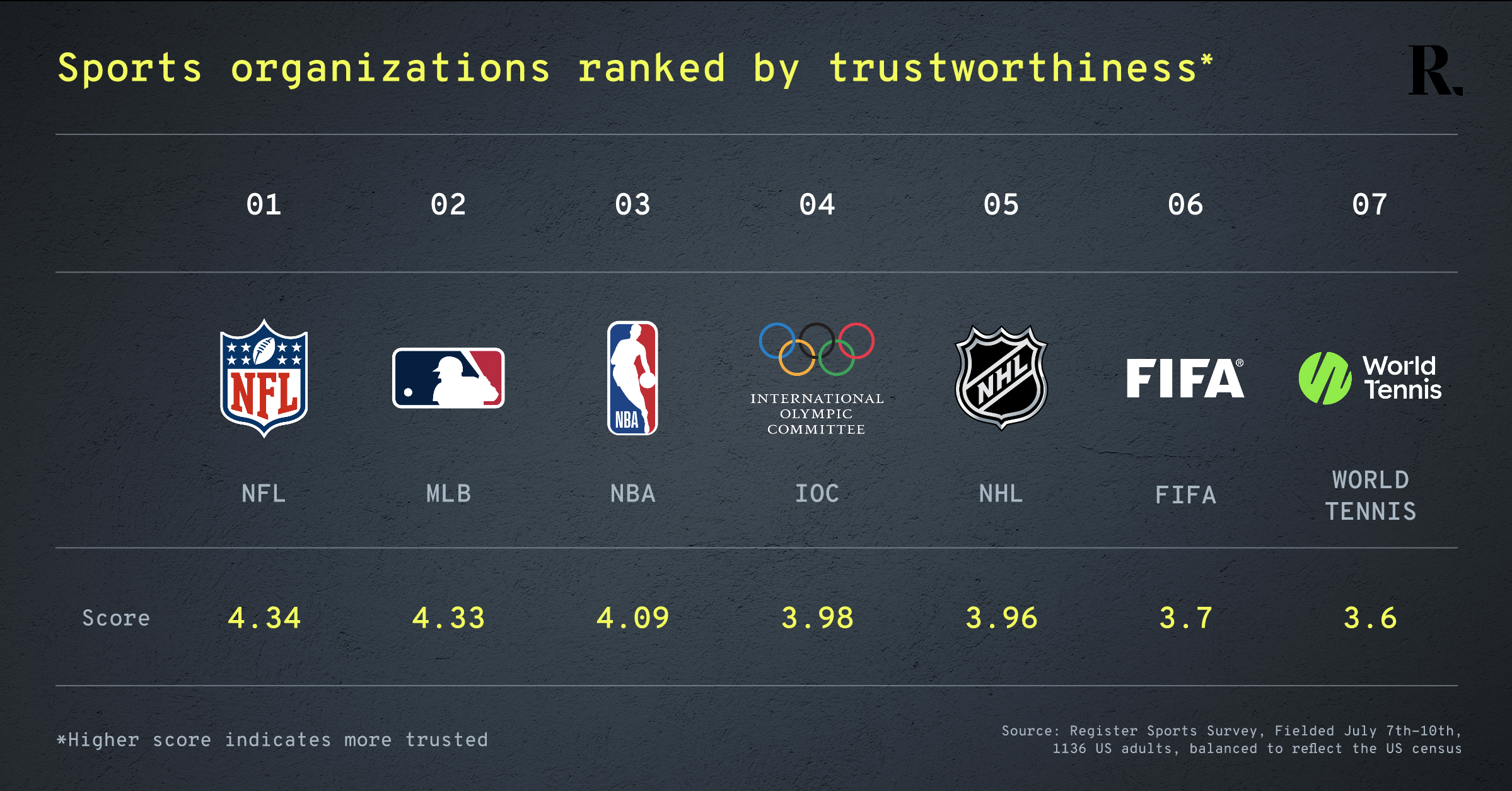
Americans' trust aligns closely with their viewing habits, with the “big four” still dominating (despite the Olympics’ temporary, quadrennial rise in popularity). Perhaps these leagues have genuinely earned Americans' trust. Or, to quote Hamlet, do we “...rather bear those ills we have / Than fly to others that we know not of?” Is their trust earned, or is it simply a case of the devil you know? Despite CTE, steroids, gambling, and doping scandals, the big four and IOC have clearly separated themselves from FIFA and World Tennis.
While we acknowledge the bias for trusting what you know, it is interesting to see FIFA – particularly during a very popular, North America-hosted World Cup – rank so low. Anyone who follows FIFA and the World Cup is certainly aware of the organization's controversy-laden past. Perhaps most noteworthy is the corruption case surrounding former FIFA President Sepp Blatter, which led to his ban from all football-related activities for nearly 13 years.
This World Cup has also had its share of controversy. While the usual Internet troll claims of “rigging” have been widespread on X, Threads, and in the shadowy back alleys of Reddit, the most notable occurrence was undoubtedly the reversal of USMNT Striker Folarin Balogun’s red card suspension following the US’s round of 32 game against Bosnia and Herzegovina, making him available against Belgium in the Round of 16. To quote The Athletic, “FIFA’s unprecedented decision to essentially rescind Balogun’s suspension — following a call from U.S. President Donald Trump and extensive work by lawyers and U.S. Soccer officials — has irreversibly changed the story of the American World Cup.” A sitting President of the United States calling the President of FIFA to reverse a call is certainly a remarkable display of brazen political involvement in sports, bold enough to garner criticism from Sepp Blatter himself. This event caused a massive stir and a huge outpouring of anger from fans and soccer executives the world over. Fortunately for them, the USMNT’s run ended against Belgium despite Balogun’s return – perhaps a glimmer of poetic justice for those who found Trump’s actions to be an existential attack on the sanctity of the sport.
When politics and sports mix, there can be no denying that interesting things happen. To examine what effect Americans’ politics have on their views of the various sports leagues, we cut our data along political lines:
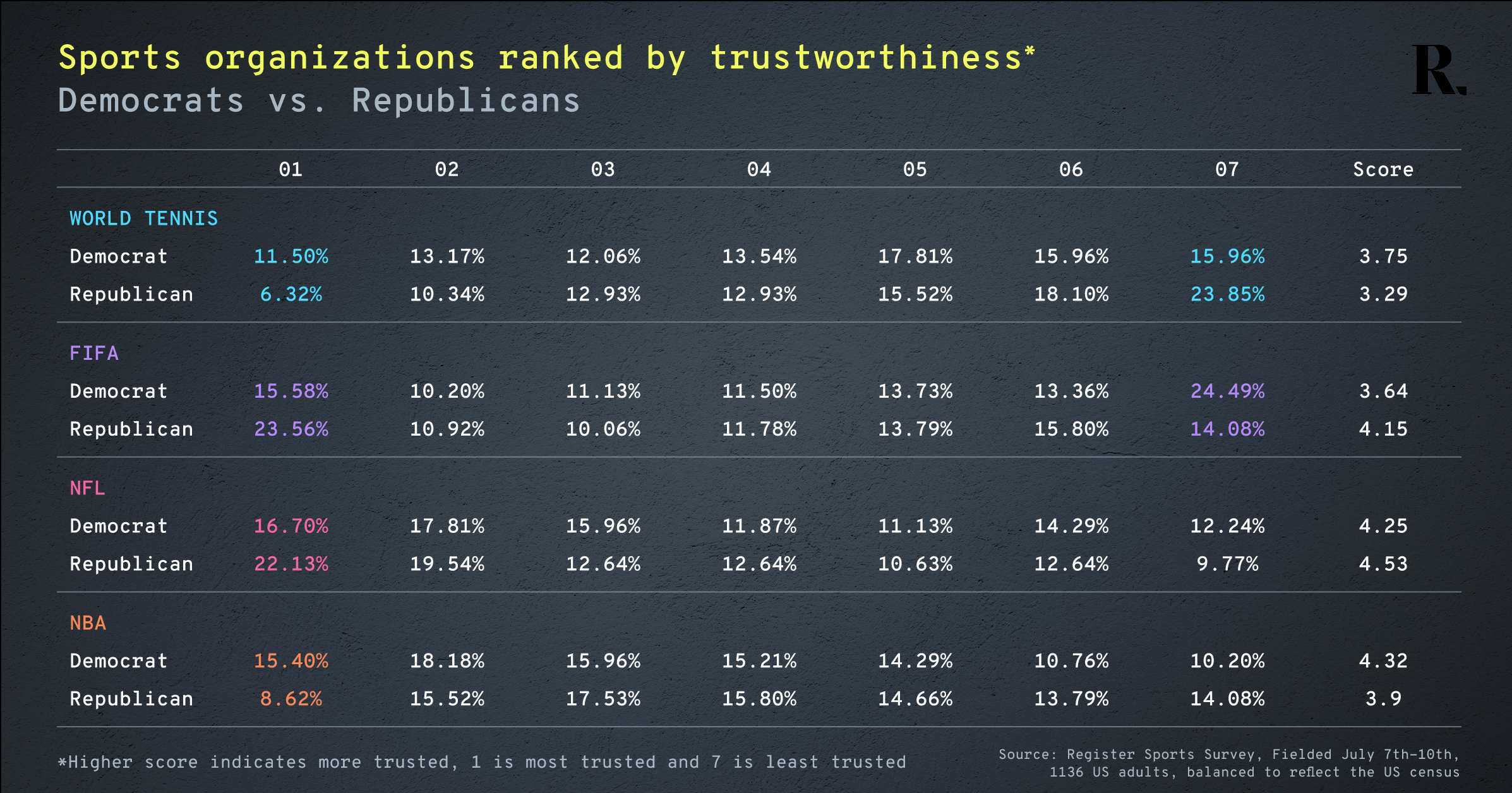
We saw several statistically significant gaps between the two parties. Beginning with FIFA, Democrats gave the organization a significantly lower overall score, with large gaps between votes on Rank 1 (most trustworthy) and Rank 7 (least trustworthy). Just shy of 8% more Republicans ranked FIFA a 1 out of 7, while over 10% more Democrats voted FIFA a 7 out of 7. Given the timing of our survey, we hypothesize that this gap is not merely coincidental but likely the result of Republicans backing their party’s actions and Democrats opposing those actions during the ongoing tournament. Other differences include higher percentages of Democrats trusting World Tennis and the NBA, while more Republicans trust the NFL, but none of the differences were as profound as those concerning FIFA.
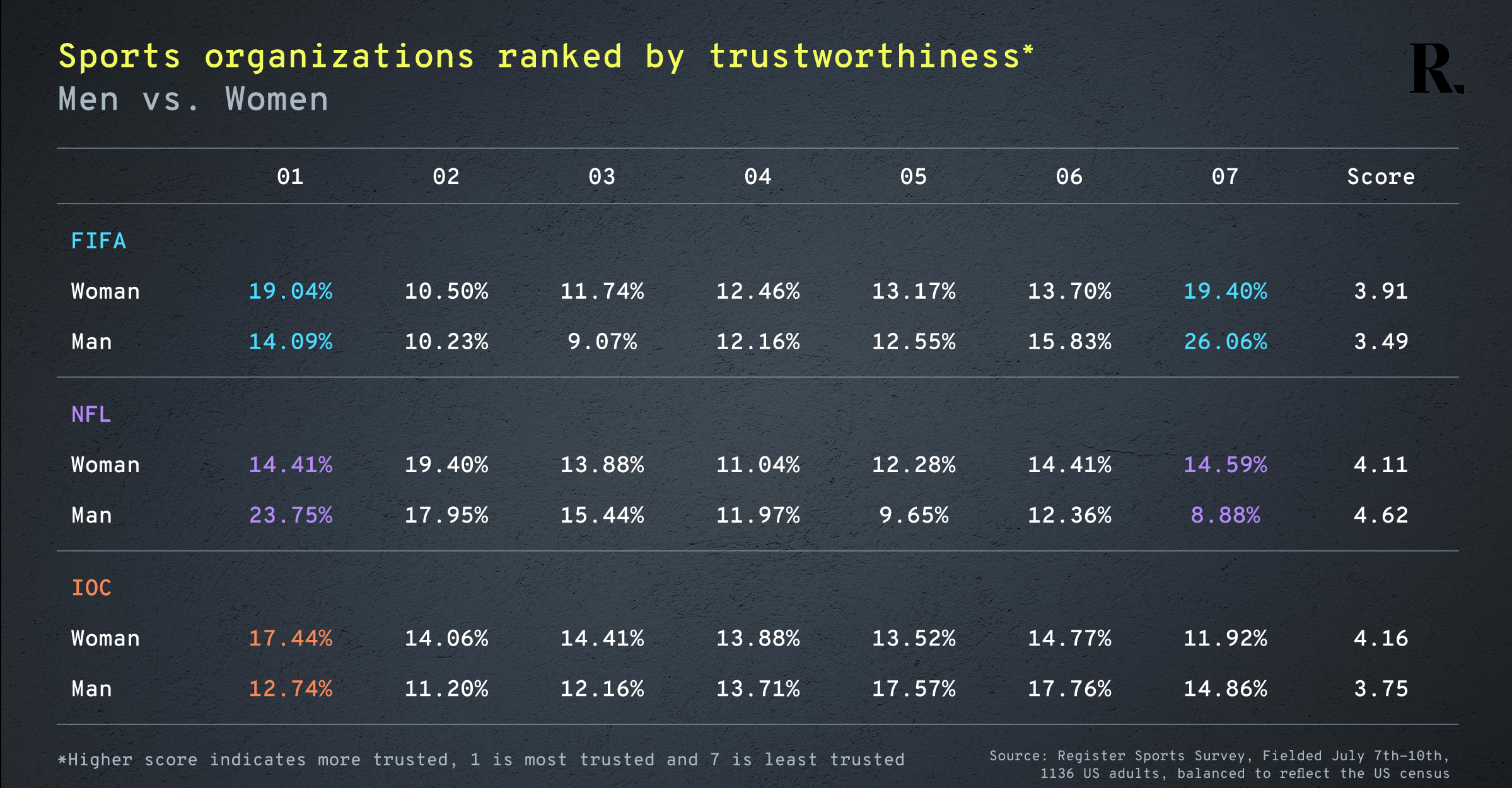
We also examined our data by gender and found significant gaps – with 5% more women ranking FIFA as highly trustworthy (1 out of 7) and ~7% more men ranking it as entirely untrustworthy (7 out of 7). The NFL also saw a significant shift between men and women, with over 9% more men ranking the league 1 out of 7, while ~6% more women ranked it 7 out of 7. The overall “Trustworthiness Score” for the NFL was also far higher among men, by over 0.5 points.
Finally, given the inherently global nature of the World Cup, we also wanted to understand how many of our respondents were globally minded. When split by holding a passport vs. not holding a passport, the results were as follows:
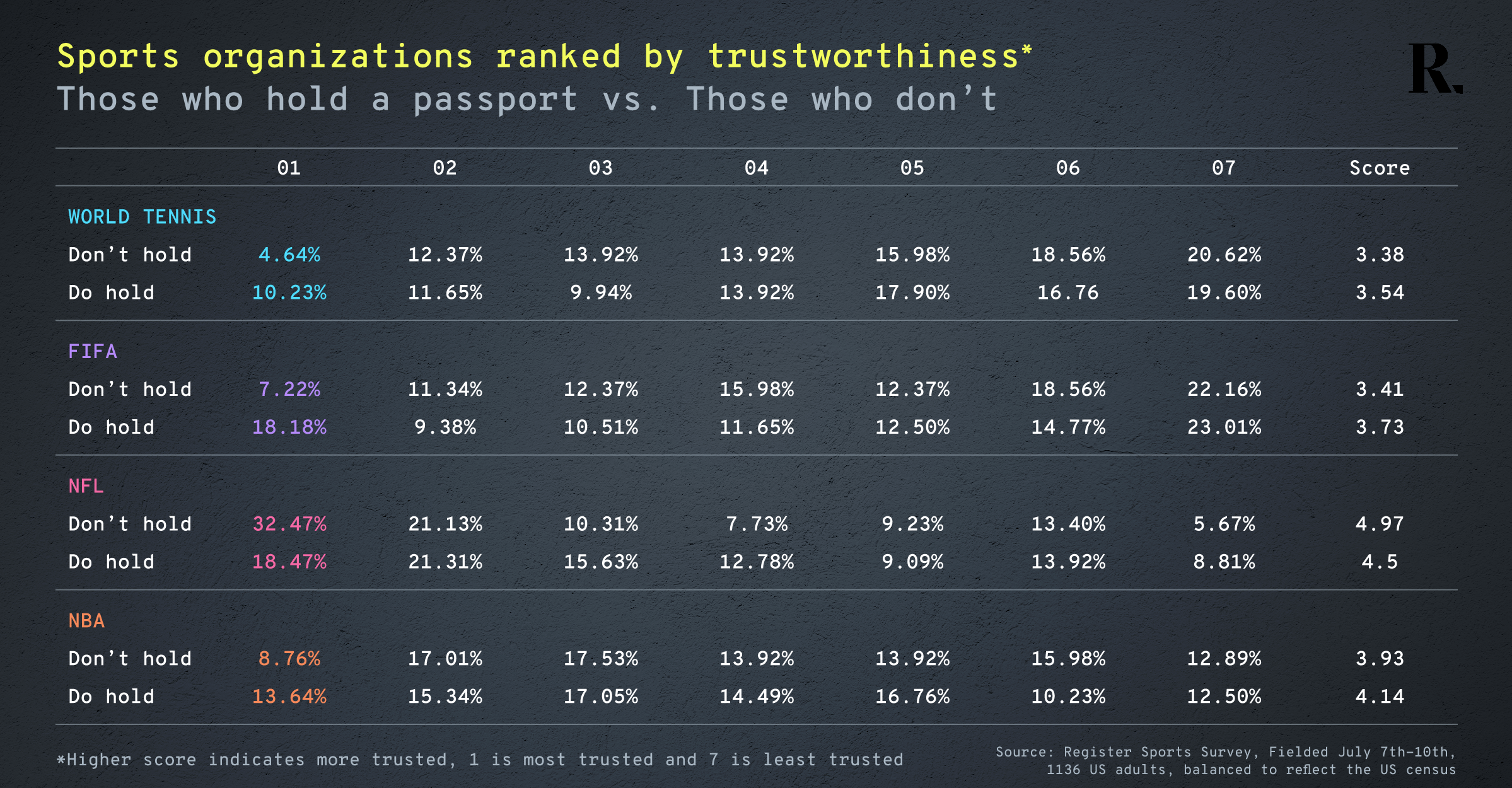
World Tennis, FIFA, and the NBA were all significantly more trusted by those who hold a passport, while the NFL showed the largest gap of all, with those without a passport giving the league 14% more highly trustworthy (1 out of 7) votes than those with a passport.
Across all of the data cuts we reviewed, the various sporting organizations and leagues ranked differently and were trusted by different people, but FIFA was always among those with the most significant differences. Its consistent appearance on every list made one thing abundantly clear: even with the World Cup returning to the US, FIFA is clearly a polarizing organization. And while popularity, viewership, and the success of the U.S. team are all favorable winds FIFA is hoping to harness for growth in this country, its less-than-clean past remains an anchor, slowing its progress.
No matter how much we disagree on FIFA, there is one thing we can all agree on – there’s nothing quite like the World Cup.